
New vs Pre-Owned Car: The Real Cost of Splurging vs Saving on Your Next Vehicle
"I can afford the monthly payment."
This single thought has trapped more car buyers in financial regret than any other. Nearly 40% of car buyers regret their purchase, with the top regrets being buying an unaffordably expensive car and not doing enough research. The dealership makes it easy to focus on that monthly number - but that number is only the beginning of what a car actually costs you.
After a home, a car is likely the second-largest purchase you will make. And unlike a home, it is a depreciating asset that loses value the moment you drive it off the lot. Whether you are considering splurging on a brand-new model with that new car smell, or saving money with a certified pre-owned vehicle, understanding the real financial impact is critical.
Let us break down what splurging versus saving actually means for your wallet over the life of the vehicle.
The Uncomfortable Truth About Depreciation
Before we dive into new versus pre-owned, you need to understand the single biggest cost of any car purchase: depreciation.
For New Cars:
- New cars lose 23.5% of their MSRP in the first year alone
- More than 10% of value disappears in the first month
- By year five, most new cars have lost roughly 60% of their original value
- Some models depreciate even faster - luxury vehicles and EVs can lose 40-45% in year one
For Pre-Owned Cars:
- A 3-year-old car has already absorbed the steepest depreciation hit
- Depreciation slows significantly: about 10% in year four versus 20-30% in year one
- A car depreciates more in its first five years than it will in the next 10 years
What This Means in Real Dollars:
A $40,000 new car becomes a $30,600 car after one year (at 23.5% depreciation). That is $9,400 lost - more than most people spend on rent in three months.
That same car, purchased as a 3-year-old used vehicle for $22,000, might depreciate to $19,800 after one year of your ownership. You "lost" $2,200 instead of $9,400.
The math is brutal: new car buyers subsidize depreciation so used car buyers do not have to.
Breaking Down Total Cost of Ownership
The sticker price and monthly payment are just the opening act. Here is what car ownership actually costs, according to AAA's analysis:
Average Annual Cost: $11,577/year or $965/month
This includes:
- Depreciation - The biggest cost (40-50% of total)
- Financing - Interest paid on loans
- Insurance - Higher for new/expensive cars
- Fuel - Variable by vehicle and driving habits
- Maintenance & Repairs - Increases with vehicle age
- Registration & Taxes - Often based on vehicle value
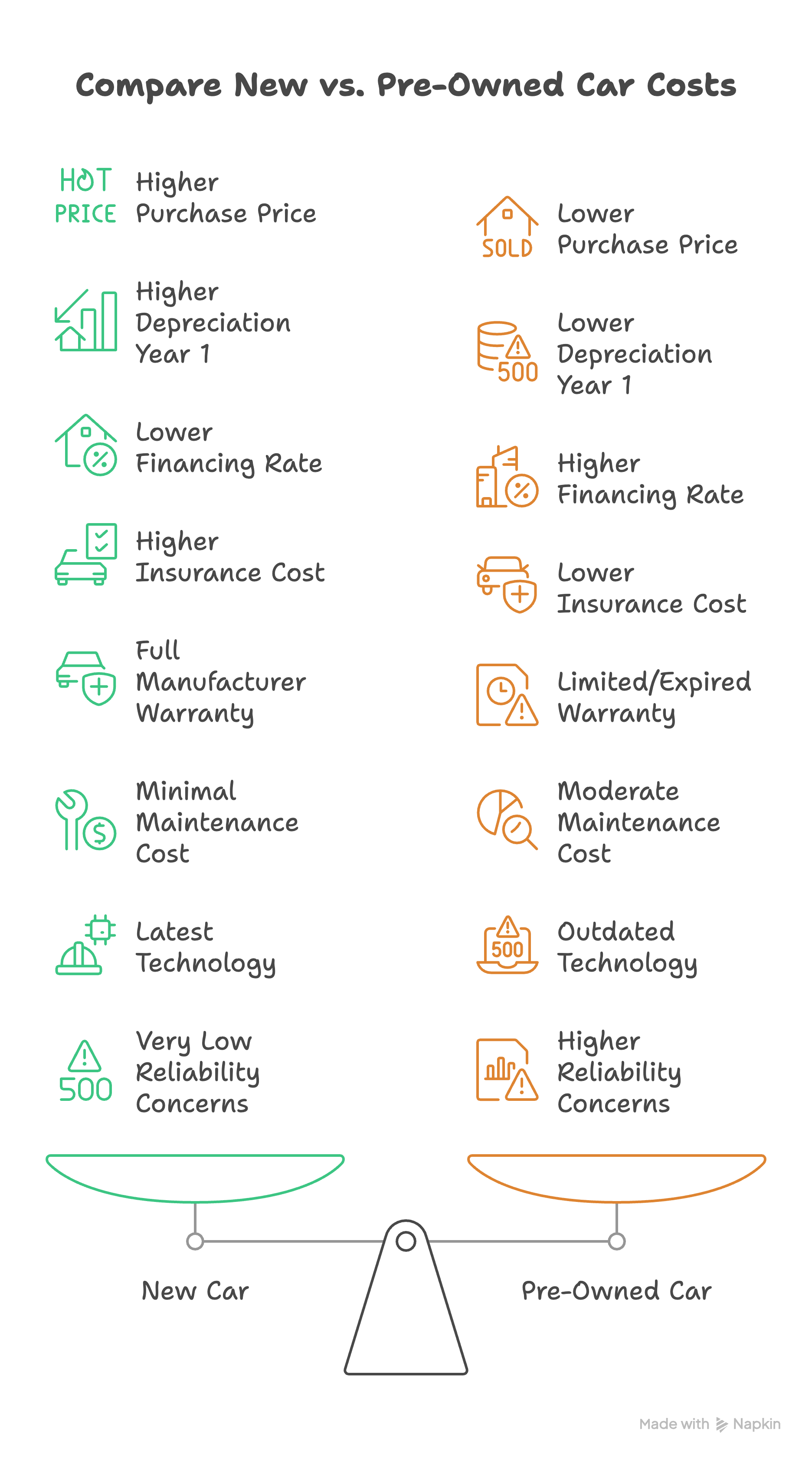
Let us compare a new car versus a pre-owned purchase on each of these factors:
| Cost Category | New Car | Pre-Owned Car | Winner |
|---|---|---|---|
| Purchase Price | $50,080 (avg) | $25,945 (avg) | Pre-owned |
| Depreciation Year 1 | -$11,769 (23.5%) | -$2,595 (10%) | Pre-owned |
| Financing Rate | 6.8% APR avg | 11.54% APR avg | New |
| Insurance (annual) | Higher (vehicle value-based) | Lower (~15-30% less) | Pre-owned |
| Warranty | Full manufacturer warranty | Limited/expired (unless CPO) | New |
| Maintenance Year 1-3 | Minimal ($100-300/year) | Moderate ($1,000+/year) | New |
| Technology/Features | Latest safety & tech | 3-5 years behind | New |
| Reliability Concerns | Very low | Higher (depends on history) | New |
Neither choice is universally "better." The right answer depends on your financial situation, priorities, and how long you plan to keep the vehicle.
When Splurging on a New Car Makes Sense
Let us be clear: buying new is not always foolish. Here are scenarios where the depreciation hit might be worth it:
1. You Plan to Keep It 10+ Years
If you drive cars into the ground, you will experience the entire depreciation curve anyway. The difference is you get:
- Full warranty coverage during high-use years
- No unknown maintenance history
- Latest safety technology
- Lower maintenance costs in early years
The math works when: Your cost-per-year over 10-15 years beats buying used every 5-7 years.
2. You Can Access Low-Interest Financing
Many manufacturers offer 0-3% APR financing on new cars - rates you cannot get on used vehicles where rates average 11.54% or higher.
Example:
- $30,000 new car at 2.9% APR for 60 months = $2,256 in interest
- $20,000 used car at 11.5% APR for 60 months = $6,407 in interest
Even though the used car costs $10,000 less, you pay $4,151 MORE in interest. The financing advantage can partially offset depreciation.
3. You Prioritize Warranty and Peace of Mind
Some people value the certainty of a warranty over saving money. If the thought of a $3,000 transmission repair keeps you up at night, paying for new-car security might be worth the premium.
This is about your risk tolerance, not just math.
4. You Need Specific Technology or Safety Features
Features like adaptive cruise control, lane-keeping assist, and blind-spot monitoring are standard on 2024-2026 models but rare on 2019-2021 used cars.
If these features meaningfully improve your safety or quality of life, paying for them may be justified.
5. Your Income Comfortably Supports It
If you earn $200,000/year, drive 30,000 miles annually, and a new $50,000 car represents 25% of gross income, the depreciation hit is different than for someone earning $60,000 buying the same car.
The 20/4/10 rule (explained below) helps you determine if "new" fits your income.
When Buying Pre-Owned Makes Financial Sense
For most people, buying pre-owned is the smarter financial move. Here is when it is especially advantageous:
1. You Want to Avoid the Depreciation Cliff
Buying a 3-5 year old car means someone else absorbed the 40-60% value drop. You get 80-90% of the car's useful life for 40-50% of the original price.
Best value sweet spot: 3-year-old certified pre-owned vehicles from reliable brands (Toyota, Honda, Mazda, Subaru).
2. You Are Working on Debt or Building Savings
If you have student loans, credit card debt, or a thin emergency fund, a cheaper used car frees up cash flow for financial priorities that actually build wealth.
Reality check: A new car does not build wealth. It is a tool. Buy the cheapest reliable tool that meets your needs.
3. You Drive Low Miles or Have Short Commute
If you drive under 10,000 miles per year, you are not using the car enough to justify paying the new-car premium. A well-maintained used car will serve you just fine with minimal wear.
4. You Want Lower Insurance Costs
Insurance on a $25,000 used car can be 15-30% cheaper than on a $50,000 new car. Over 5 years, this saves thousands.
5. You Are Financially Uncertain
Job insecurity? Unstable income? Unexpected medical bills? A cheaper used car gives you financial flexibility. You can sell it with less loss if circumstances change.
The Middle Ground: Certified Pre-Owned (CPO)
CPO vehicles bridge new and used, offering some benefits of both:
What You Get:
- Extended warranty coverage (typically 1-2 years beyond original warranty)
- Thorough multi-point inspection
- Roadside assistance
- Vehicle history verification
- Return/exchange policies (varies by brand)
What You Pay: CPO cars cost 2-5% more than non-certified used cars - about $450-$1,300 extra on a $25,000 vehicle.
Best CPO Programs (2026):
- Kia: 10-year/100,000-mile powertrain warranty
- Honda: 7-year/100,000-mile powertrain coverage
- Toyota: 7-year/100,000-mile powertrain warranty
- Hyundai: 10-year/100,000-mile powertrain warranty
When CPO Makes Sense: You want a used car price but new car peace of mind, especially for brands with expensive repairs (luxury vehicles, European makes).
The 20/4/10 Rule: Can You Actually Afford It?
Before you decide new versus used, determine what you can afford using the 20/4/10 rule:
20% Down Payment
This reduces your loan amount, lowers interest costs, and prevents being underwater (owing more than the car is worth).
Red flag: If you cannot save 20% down, you likely cannot afford that car.
4-Year Loan Maximum
The longer the loan, the more interest you pay and the higher the risk of negative equity.
Financial experts warn that 72-84 month loans are a trap. Your monthly payment looks affordable, but you pay thousands extra in interest while the car depreciates faster than you pay down the loan.
Example:
- $30,000 car at 7% APR for 48 months = $718/month, $4,461 total interest
- $30,000 car at 7% APR for 72 months = $512/month, $6,864 total interest
You pay $2,403 MORE in interest for a lower monthly payment.
10% of Gross Income
Total monthly vehicle costs (payment + insurance + gas + maintenance) should not exceed 10% of your gross monthly income.
Income-Based Affordability Examples:
| Annual Income | Monthly Gross | Max Car Costs (10%) | Max Loan Amount (approx) |
|---|---|---|---|
| $50,000 | $4,167 | $417 | $15,000-18,000 |
| $75,000 | $6,250 | $625 | $23,000-28,000 |
| $100,000 | $8,333 | $833 | $30,000-38,000 |
| $150,000 | $12,500 | $1,250 | $50,000-60,000 |
Most Americans violate this rule. Average new car price is $50,080 - which would require $125,000+ annual income under the 20/4/10 rule.
Hidden Costs You Cannot Ignore
Beyond the monthly payment, these costs add up fast:
1. Sales Tax (4-8% of Purchase Price)
On a $30,000 car in a state with 6% sales tax, that is $1,800 due at purchase.
Some states tax used cars at lower rates, making pre-owned even cheaper.
2. Registration and Title Fees
Annual registration fees range from $60-300 depending on your state and vehicle value.
Many states base registration fees on car value - another reason used cars cost less.
3. Insurance
New cars cost more to insure because:
- Higher replacement value
- Required comprehensive/collision coverage if financed
- Higher repair costs for modern technology
Average difference: 15-30% higher for new versus comparable used car.
4. Maintenance and Repairs
New cars (years 1-3): Minimal - maybe $100-300/year for oil changes Used cars (3-7 years old): $1,000-1,500/year for routine maintenance Used cars (8+ years old): $1,500-3,000/year with increasing repair risk
Important: A single major repair on an out-of-warranty used car can wipe out the savings versus buying new. This is why CPO warranties matter.
5. Fuel Costs
Newer cars often have better fuel economy, though this gap has narrowed. A 2022 car averages 25 MPG; a 2026 car might get 28-30 MPG.
Annual savings (driving 12,000 miles at $3.50/gallon):
- 25 MPG: $1,680/year
- 30 MPG: $1,400/year
- Savings: $280/year (not enough to justify new car premium alone)
6. Total Hidden Costs
Average monthly hidden costs: $575 or $6,900/year - and this does not include your car payment.
Real-World Scenarios: New vs Pre-Owned
Let us compare real scenarios to see the financial impact:
Scenario 1: Sarah - $60,000 Income, First Car
Option A: New Car
- Purchase: $32,000 new Honda Civic
- Down payment (20%): $6,400
- Loan: $25,600 at 6.8% for 48 months = $609/month
- Insurance: $180/month
- Gas: $140/month
- Maintenance: $50/month
- Total: $979/month (19.6% of gross income) Violates 10% rule
Option B: Used Car
- Purchase: $18,000 used 2021 Honda Civic (CPO)
- Down payment (20%): $3,600
- Loan: $14,400 at 8.5% for 48 months = $356/month
- Insurance: $135/month
- Gas: $140/month
- Maintenance: $110/month
- Total: $741/month (14.8% of gross income) ⚠️ Better, but still high
Option C: Affordable Used Car
- Purchase: $12,000 used 2019 Toyota Corolla
- Down payment (20%): $2,400
- Loan: $9,600 at 9% for 48 months = $239/month
- Insurance: $115/month
- Gas: $140/month
- Maintenance: $100/month
- Total: $594/month (11.9% of gross income) Closer to guideline
Winner for Sarah: Option C. The new car would stretch her budget dangerously thin, leaving little room for savings or emergencies.
Scenario 2: Michael - $120,000 Income, Upgrading Car
Option A: New Luxury SUV
- Purchase: $65,000 new BMW X5
- Down payment (20%): $13,000
- Loan: $52,000 at 5.9% for 48 months = $1,223/month
- Insurance: $280/month
- Gas: $220/month
- Maintenance: $100/month (warranty coverage)
- Total: $1,823/month (18.2% of gross income) Exceeds 10% rule
Option B: Certified Pre-Owned Luxury
- Purchase: $38,000 CPO 2022 Lexus RX (3 years old)
- Down payment (20%): $7,600
- Loan: $30,400 at 7.5% for 48 months = $735/month
- Insurance: $210/month
- Gas: $200/month
- Maintenance: $120/month
- Total: $1,265/month (12.7% of gross income) ⚠️ Slightly over
Option C: New Reliable SUV
- Purchase: $42,000 new Toyota RAV4
- Down payment (20%): $8,400
- Loan: $33,600 at 5.5% for 48 months = $784/month
- Insurance: $190/month
- Gas: $170/month
- Maintenance: $60/month
- Total: $1,204/month (12% of gross income) ⚠️ Acceptable range
Winner for Michael: Option C or B depending on priorities. Michael can afford a nicer car, but the luxury SUV is still a stretch. The CPO Lexus offers luxury for less, while the new RAV4 provides reliability with lower total costs.
Scenario 3: The 10-Year Ownership Comparison
Let us see total cost of ownership over 10 years:
Option A: New Car ($35,000 purchase)
- Purchase price: $35,000
- Financing (20% down, 4 years, 6%): $3,600 interest
- Insurance (10 years avg $170/month): $20,400
- Maintenance & repairs (years 1-10): $12,000
- Fuel (120k miles at $3.50/gal, 28 MPG): $15,000
- Registration/fees (10 years): $2,000
- Total 10-year cost: $88,000
- Resale value (year 10, ~25% of original): -$8,750
- Net cost: $79,250 or $7,925/year
Option B: Used Car ($18,000 purchase, 3 years old)
- Purchase price: $18,000
- Financing (20% down, 4 years, 9%): $2,800 interest
- Insurance (10 years avg $140/month): $16,800
- Maintenance & repairs (years 1-10): $18,000
- Fuel (120k miles at $3.50/gal, 27 MPG): $15,556
- Registration/fees (10 years): $1,500
- Total 10-year cost: $72,656
- Resale value (year 10, minimal): -$2,000
- Net cost: $70,656 or $7,066/year
Savings with used car: $8,594 over 10 years
This assumes both cars last 10 years. If the used car requires a major repair ($4,000 transmission), the gap narrows to $4,594. If it needs multiple repairs, buying new might have been better.
The takeaway: Used cars usually save money IF you buy reliable brands and budget for maintenance.
Your Car-Buying Decision Framework
Here is a decision tree to guide your choice:
Start Here: Can You Pass the 20/4/10 Test?
NO → Stop. You cannot afford this car. Consider:
- A cheaper vehicle
- Saving a larger down payment
- Increasing income before purchasing
- Using public transit/car-sharing temporarily
YES → Continue to next question.
How Long Will You Keep This Car?
Less than 5 years → Buy used. You will not keep it long enough to justify eating new-car depreciation.
5-7 years → Either works. Compare total costs (use calculators at Edmunds TCO or KBB Cost of Ownership).
8+ years → New or CPO makes sense. You will spread costs over more years and benefit from warranty coverage.
What Is Your Financial Stability?
Unstable income, debt, or thin savings → Buy cheap used. You need flexibility and cash reserves more than a nice car.
Stable income, emergency fund, no high-interest debt → You have options. New or used can work depending on preferences.
What Are Your Priorities?
Lowest total cost → Used (3-5 years old) from reliable brand Buy: Toyota Camry, Honda Accord, Mazda3, Subaru Outback (2019-2022 models)
Peace of mind + warranty → New or CPO Buy: New Toyota/Honda OR CPO Lexus/Honda with strong warranty
Latest tech + safety → New Buy: 2025-2026 model with advanced driver assistance systems
Luxury experience + value → CPO luxury Buy: CPO Lexus, Acura, Genesis (3-4 years old with warranty remaining)
Special Case: Interest Rates
If new car APR < 4% AND used car APR > 10%: The financing advantage of new might offset depreciation. Run the numbers.
If you can pay cash: Used cars make even more sense. Avoid paying interest, invest the difference.
Common Car-Buying Mistakes to Avoid
Based on research showing 40% of buyers have regrets, here are the top mistakes:
1. Focusing Only on Monthly Payment
Dealerships love stretching loans to 72-84 months to hit your "target payment." You pay far more in interest and stay underwater longer.
Fix: Focus on total price, interest rate, and loan term - not just monthly payment.
2. Skipping the Pre-Purchase Inspection (Used Cars)
A $150 pre-purchase inspection can save you from buying a $15,000 problem.
Fix: Always get used cars inspected by an independent mechanic before purchase.
3. Not Shopping Around for Financing
Dealer financing is rarely the best rate. Get pre-approved from banks/credit unions before shopping.
Fix: Compare rates from 3-5 lenders. A 2% rate difference saves thousands.
4. Buying More Car Than You Need
The average new car buyer regret? Choosing the wrong model or overpaying.
Fix: Buy the car that meets your needs, not your wants. A Corolla gets you to work just as reliably as a BMW.
5. Trading In Too Soon
Trading in after 2-3 years means you eat maximum depreciation and start the cycle over.
Fix: Keep cars 7-10 years to spread depreciation and maximize value.
6. Ignoring Total Cost of Ownership
A cheap purchase price means nothing if insurance, repairs, and gas cost a fortune.
Fix: Use TCO calculators. A $5,000 cheaper car that costs $2,000/year more to own is not a deal.
7. Emotional Purchasing
Nearly 70% of Americans have financial regrets, and impulsive car purchases top the list.
Fix: Sleep on it. Test drive multiple cars. Never buy the first day you shop.
The Bottom Line: New vs Pre-Owned
Here is the uncomfortable truth: most people should buy used cars.
Not because new cars are bad - they are wonderful. But because:
- Depreciation is brutal - You lose $10,000+ in year one on a new car
- Financing costs more - Used car loans have higher rates, but smaller loan balances
- Reliable used cars exist - Toyotas, Hondas, and Mazdas routinely last 200,000+ miles
- Most people overspend - Cheaper cars = more cash for investments, debt payoff, or savings
Buy new IF:
- You can comfortably afford it (passes 20/4/10 rule with room to spare)
- You will keep it 10+ years
- You can access low APR financing (under 4%)
- You prioritize warranty and peace of mind
- Your income makes the depreciation hit manageable
Buy pre-owned IF:
- You want to maximize value and avoid depreciation
- You are building wealth and need to free up cash flow
- You are okay with occasional maintenance/repairs
- You drive low miles or have a short commute
- You are working on debt or building emergency funds
Buy CPO IF:
- You want used-car value with new-car peace of mind
- You are buying a luxury brand (expensive repairs)
- Extended warranty coverage is worth $500-1,500 to you
Action Steps: Your Next Move
Before you buy any car:
1. Calculate What You Can Truly Afford
- Use the 20/4/10 rule
- Include ALL costs: payment, insurance, gas, maintenance, registration
- Build a 10% buffer for unexpected repairs
2. Get Pre-Approved for Financing
- Check rates from your bank, credit union, and online lenders
- Know your rate BEFORE you step into a dealership
- Aim for APR under 7% (new) or 10% (used)
3. Research Reliability and Total Cost of Ownership
- Check Consumer Reports, J.D. Power, and Edmunds TCO
- Target brands with proven reliability (Toyota, Honda, Mazda, Subaru)
- Avoid models with known expensive issues
4. Test Drive and Inspect
- Drive multiple cars to compare
- For used cars: Get independent mechanic inspection ($100-200)
- Check vehicle history report (Carfax/AutoCheck)
5. Negotiate the Total Price, Not Monthly Payment
- Focus on out-the-door price
- Negotiate trade-in separately
- Do not sign for extended warranties or dealer add-ons without research
6. Sleep On It
- Never buy the same day you start shopping
- Take 48 hours to review numbers and options
- Remember: 40% of buyers have regrets - do not be one of them
Final Thoughts
A car is not an investment - it is a tool that costs money. The question is not "new versus used?" but rather "what is the smartest way to meet my transportation needs while building wealth?"
For most people, buying a reliable 3-5 year old car and driving it for 10+ years is the financially optimal choice. You avoid the depreciation cliff, pay less in insurance and financing, and free up cash flow for actual investments.
But if you earn a high income, plan to keep the car forever, and value warranty coverage - buying new can make sense too. Just make sure it passes the 20/4/10 test and fits comfortably in your budget.
The goal is not to never buy a new car. The goal is to make intentional decisions aligned with your financial priorities - not dealer sales tactics or keeping up with your neighbors.
Whether you choose new or pre-owned, make it a conscious choice backed by research, not an impulsive decision you regret when the first payment hits.
Sources
- LendingTree: Nearly 4 in 10 Who Bought a Car in the Past Year Have Regrets
- Kelley Blue Book: Study - 40% of New Car Buyers Have Regrets
- Ipsos: Top Car Buyer Regrets Include Overpaying for a New Car
- Ramsey Solutions: Car Depreciation - How Much Is Your Car Worth?
- Experian: How Much Do Cars Depreciate Per Year?
- AARP: New vs Used Car Depreciation Guide
- NerdWallet: What Is the Total Cost of Owning a Car?
- State Farm: New vs Used Car Calculator - Cost of Ownership
- Yahoo Finance: I Asked a Car Expert - Will It Be Better To Buy Used or New in 2026?
- Consumer Reports: What Do Certified Pre-Owned Car Programs Cover?
- Car and Driver: Warranties for CPO, Used, and New Cars - Which Is Right?
- Capital One: What Is the 20/4/10 Rule for Car Buying?
- J.D. Power: What Is the 20/4/10 Rule of Buying and Financing a Car?
- CNBC: How the 20-4-10 Car Shopping Rule Works
- JSB Bank: The Hidden Costs of Car Ownership - Maintenance, Taxes and More
- Great Northwest FCU: The Hidden Costs of Owning a Car
- Wessels Used Cars: New vs Used Car Maintenance Costs and True Cost
- CarEdge: What's a Better Value in 2025 - New or Used Car? Experts Weigh In
- GoBankingRates: 5 Used Cars That Are a Better Buy Than New in 2026
- Bankrate: How Much Car Can I Afford? How to Estimate Your Payment
- RefiJet: How Much Should Your Car Payment Be Based on Income
- New Trader U: 5 Financial Splurges You're Most Likely to Regret
- Edmunds: Cost of Car Ownership - 5-Year Cost Calculator
- KBB: Cost of Car Ownership - Total Cost Calculator
Frequently Asked Questions
How much does a new car depreciate in the first year?
New cars lose 20-30% of their value in the first year, with an average of 23.5% according to Edmunds. Some vehicles lose more than 10% in just the first month of ownership.
What is the 20/4/10 rule for car buying?
The 20/4/10 rule states you should make a 20% down payment, finance for no longer than 4 years, and keep total vehicle expenses (payment, insurance, fuel, maintenance) at or below 10% of your gross monthly income.
Are certified pre-owned cars worth the extra cost?
CPO cars cost 2-5% more than non-certified used cars but include extended warranties (often 1-2 years beyond original warranty), roadside assistance, and thorough inspections. They bridge the gap between new and used.
When does buying a new car make financial sense?
Buying new makes sense when you plan to keep the car 10+ years, can access low APR financing (under 3%), prioritize warranty coverage and latest technology, and the depreciation hit fits your budget.
What are the hidden costs of car ownership?
Beyond the monthly payment, expect sales tax (4-8% of price), registration ($60-300 annually), insurance (higher for new cars), maintenance ($1,000+ annually for used), repairs, and fuel. Total hidden costs average $575/month or $6,900/year.
Should I finance a car or pay cash?
It depends on interest rates and opportunity cost. If you can get financing under 4% APR and invest cash at higher returns, financing may make sense. If used car rates exceed 10%, paying cash (if possible) saves thousands in interest.
How much should my car payment be based on my income?
Financial experts recommend keeping your car payment at 10-15% of monthly take-home pay, with total car expenses (payment, insurance, gas, maintenance) not exceeding 15-20% of take-home pay.