Every dollar you earn faces a choice: spend it now, save it for later, or invest it for growth. Mastering these trade-offs, powered by the magic of compound interest, is the key to building lasting wealth.
The Financial Flow: Earn, Save, Spend, Invest
Personal finance follows a clear sequence, but many get it wrong by spending first. Here’s the right order:
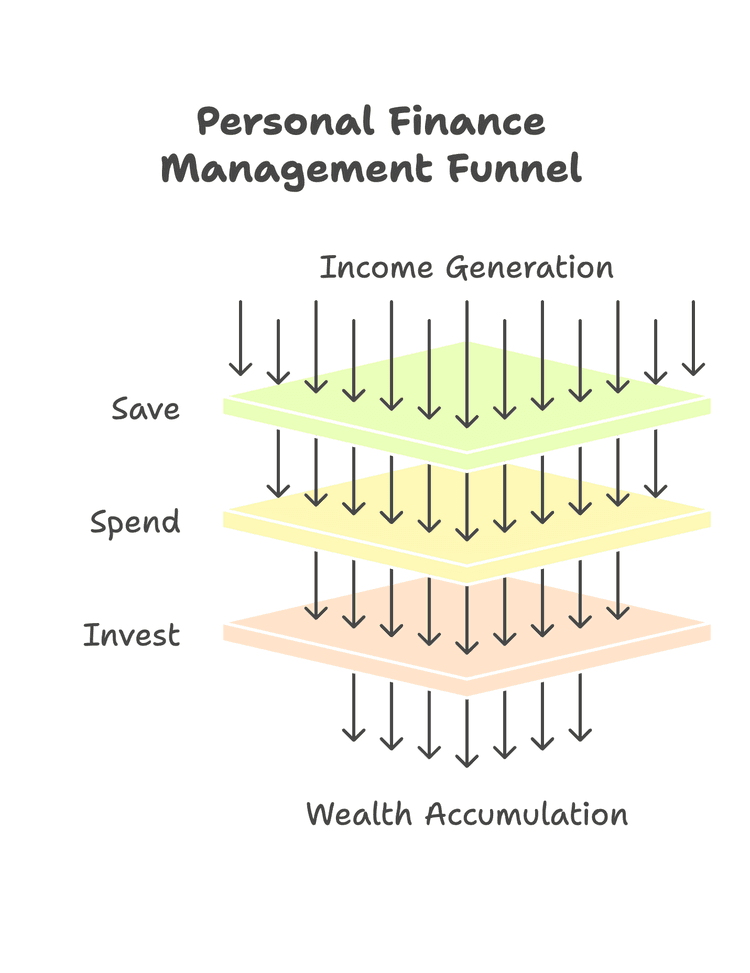
- Earn: Income from your job, side hustle, or investments.
- Save: Set aside money for emergencies and goals.
- Spend: Use what’s left for needs and wants.
- Invest: Grow your savings through assets like stocks.
Key Insight: Save before you spend. This “pay yourself first” mindset ensures you build wealth by prioritizing savings over lifestyle expenses.
Example: In 2025, a freelancer earning $5,000 monthly sets up an auto-transfer of $1,000 to a savings account before paying bills. This habit avoids lifestyle inflation, where rising income leads to unchecked spending.
The Power of Compound Interest
Compound interest turns small, consistent investments into significant wealth over time by earning returns on both your initial investment and accumulated gains.
How It Works
Unlike simple interest (fixed returns on your original amount), compound interest grows exponentially. For example, invest $1,000 at a 7% annual return:
- Year 1: $1,000 × 1.07 = $1,070
- Year 2: $1,070 × 1.07 = $1,144.90
- Year 3: $1,144.90 × 1.07 = $1,225.04
By year 3, you’re earning returns on your initial $1,000 plus the $144.90 in prior gains, amplifying growth over time.
The Importance of Time
Starting early maximizes compound interest’s impact. Consider two investors in 2025:
- Sarah (starts at 25): Invests $200/month from 2025 to 2035 (10 years, total $24,000) at 7% annual returns. By 2065, her investment grows to ~$278,000.
- Mike (starts at 35): Invests $200/month from 2035 to 2065 (30 years, total $72,000) at 7% returns. By 2065, his investment reaches ~$242,000.
Sarah’s 10-year head start, despite investing less, yields over twice Mike’s wealth, showing time’s outsized role.
Understanding Investment Returns
Different investments offer varying returns and risks. Choosing wisely aligns with your goals and timeline.
Linear vs. Exponential Returns
Linear returns (e.g., saving $100/month in a checking account) grow steadily: $1,200 after one year, $2,400 after two. Exponential returns, like those from stocks, grow by percentage, compounding over time for larger gains.
Example: In 2025, $10,000 in a 1% savings account grows linearly to $10,100 in a year. The same amount in a stock index fund at 7% could grow to $10,700, with gains compounding yearly.
Risk and Return Trade-off
Higher returns typically involve higher risk. Here’s a 2025 snapshot:
- High-yield savings (1-3%): Low risk, ideal for emergency funds.
- Government bonds (3-5%): Low risk, stable but modest returns.
- Stock index funds (6-8% avg.): Moderate risk, strong long-term growth.
- Cryptocurrency (~0-20%+): High risk, volatile but potential for high returns.
Example: In 2025, a tech worker invests in an S&P 500 index fund for retirement, accepting moderate risk for 6-8% average returns, while keeping an emergency fund in a 3% high-yield savings account for safety.
Smart Spending Framework
Every dollar spent is a dollar not saved or invested. A clear framework helps balance needs and wants.
Needs vs. Wants vs. Desires
Categorize expenses to prioritize wisely:
- Needs: Essentials like rent, groceries, and healthcare.
- Wants: Non-essentials like dining out or streaming subscriptions.
- Desires: Luxuries like designer clothing or a new car.
Example: In 2025, a family budgets for needs (mortgage, food), limits wants (weekly takeout), and cuts desires (luxury vacations) to save for a home down payment.
The 50/30/20 Rule
A simple budgeting guideline:
- 50% Needs: Housing, utilities, minimum debt payments.
- 30% Wants: Entertainment, hobbies, dining out.
- 20% Savings/Investing: Emergency fund, retirement, goals.
Example: A 2025 graduate earning $4,000/month allocates $2,000 to needs (rent, groceries), $1,200 to wants (travel, subscriptions), and $800 to savings, building a strong financial foundation.
The Psychology of Saving
Saving is hard because humans prioritize instant gratification. Smart systems work with your psychology.
Automate Your Savings
Set up automatic transfers to savings or investment accounts to save before you spend.
Example: In 2025, an employee auto-transfers 10% of their paycheck to a 401(k) and $200/month to a high-yield savings account, effortlessly building wealth.
Mental Accounting
Create separate accounts for goals (e.g., emergency fund, vacation) to stay disciplined.
Example: A 2025 couple uses separate accounts for a house down payment and travel, avoiding the temptation to dip into savings for daily expenses.
Building Your Emergency Fund
An emergency fund protects against unexpected expenses like medical bills or job loss.
How Much to Save
Aim for 3-6 months of expenses, adjusted for your situation:
- Stable job: 3 months (e.g., $9,000 for $3,000 monthly expenses).
- Unstable job: 6-12 months for added security.
Example: A 2025 freelancer saves 6 months’ expenses ($18,000) in a high-yield savings account to cover unpredictable income gaps.
Where to Keep It
Choose safe, liquid options like high-yield savings accounts offering 3-4% in 2025.
Example: A teacher in 2025 uses an online bank’s 3.5% savings account for their $10,000 emergency fund, earning interest while keeping it accessible.
The Investing Mindset
Investing puts your money at risk for higher returns, unlike saving, which prioritizes safety.
Time Horizon
Match investments to your goals’ timeline:
- Short-term (<2 years): Savings or bonds for safety.
- Long-term (10+ years): Stocks for higher returns.
Example: In 2025, a 30-year-old invests in a stock index fund for retirement, while keeping a wedding fund in a 3% savings account for a 2027 event.
Dollar-Cost Averaging
Invest a fixed amount regularly to reduce market timing risks and buy more when prices are low.
Example: A 2025 investor auto-invests $500/month in an S&P 500 ETF, buying more shares during market dips, smoothing out volatility.
Common Mistakes to Avoid
Avoid these pitfalls to stay on track:
- Lifestyle Inflation: Don’t increase spending with income. Save raises instead.
- Timing the Market: Consistent investing beats trying to predict market moves.
- Ignoring Inflation: Ensure investments outpace 2-3% inflation in 2025.
Example: In 2025, a new manager earning a raise resists buying a luxury car, instead investing the extra $1,000/month, growing their wealth faster.
Key Takeaways
- Save before spending to prioritize wealth building.
- Compound interest grows wealth exponentially with time.
- Start investing early, even with small amounts.
- Automate savings to overcome spending temptations.
- Build a 3-6 month emergency fund before investing.
With these principles, you’re ready to explore what truly drives wealth creation in the next chapter.