You use money every day, but have you ever stopped to think about what it actually is? Most people never question the nature of money—they simply accept it as a fact of life. But understanding what money really is, and why it works, is fundamental to making smart financial decisions.
The Evolution of Money
Money didn't appear overnight. It evolved over thousands of years as humans found increasingly efficient ways to trade and store value. This evolution tells us a lot about what makes money work.
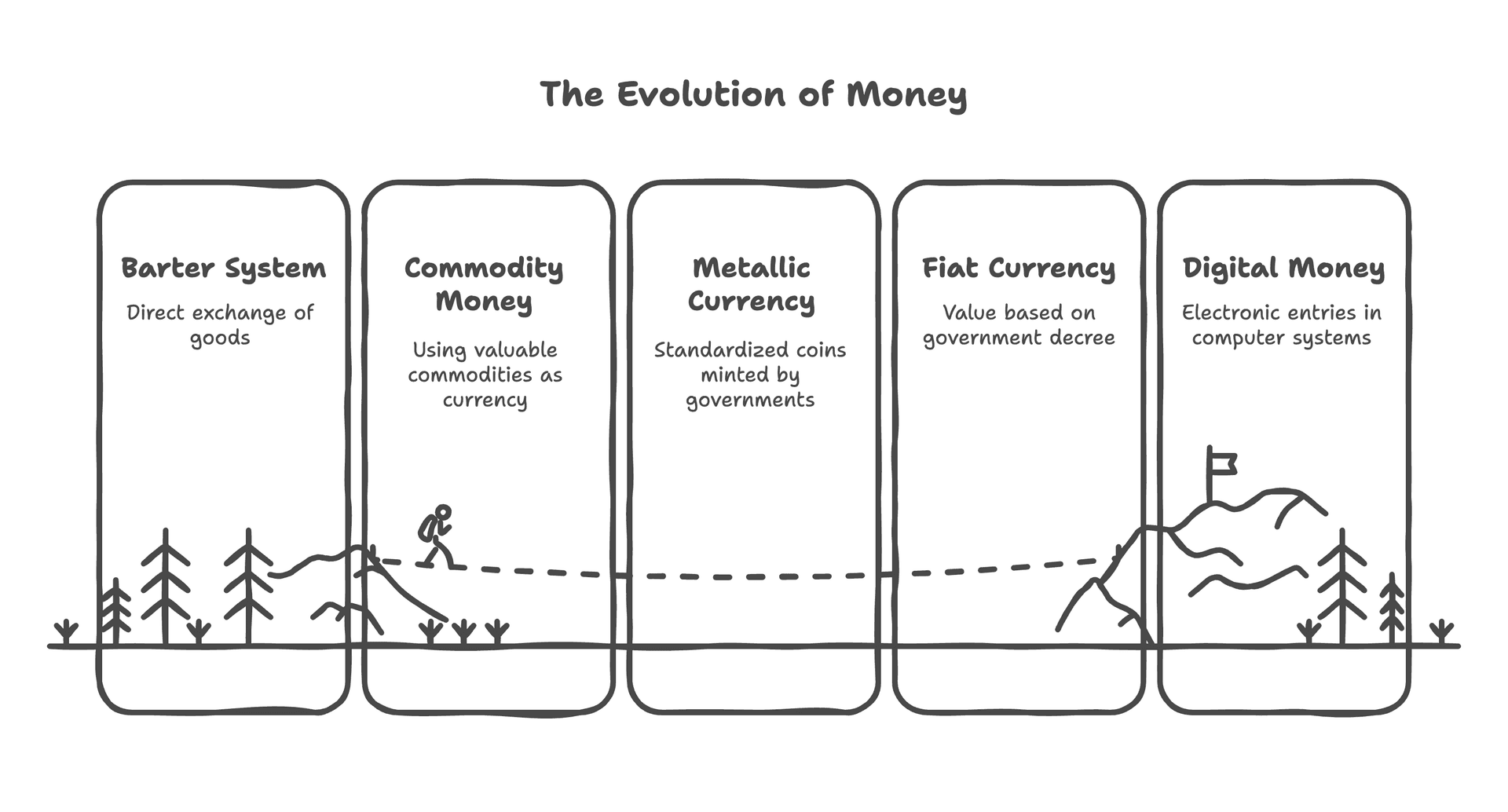
1. The Barter System
Before money existed, people traded goods directly. If you had chickens and wanted a cow, you'd need to find someone who had a cow and wanted chickens. This system had obvious problems:
- You needed a "double coincidence of wants"—both parties had to want what the other offered
- It was hard to determine fair exchange rates (how many chickens equal one cow?)
- Some goods were difficult to divide (you can't trade half a cow very easily)
- Perishable goods couldn't store value over time
2. Commodity Money
To solve these problems, societies began using valuable commodities as intermediaries. Gold, silver, cattle, shells, and even salt served as money in different cultures. These commodities had several advantages:
- They had intrinsic value—people wanted them for their own sake
- They were durable and could store value over time
- They were divisible (you could break gold into smaller pieces)
- They were portable relative to their value
The word "salary" comes from the Latin word "salarium," which referred to the payments made to Roman soldiers, sometimes in salt—a valuable commodity at the time.
3. Metallic Currency
As trade expanded, governments began minting standardized coins from precious metals. This solved the problem of having to weigh and verify the purity of metal in each transaction. Later, paper money emerged as a more convenient way to represent claims on gold or silver stored in banks.
4. Fiat Currency
In 1971, President Nixon ended the convertibility of the US dollar to gold, completing the world's transition to fiat currency. "Fiat" means "let it be done" in Latin—fiat money has value because the government says it does, not because it's backed by gold or silver.
This might sound scary—money backed by nothing but government promise—but fiat systems actually offer important advantages. They allow central banks to respond to economic crises by adjusting the money supply, something that's impossible under a gold standard.
5. Digital Money
Today, most money exists only as digital entries in computer systems. When you check your bank balance, you're looking at numbers in a database, not physical cash. Credit cards, mobile payments, and cryptocurrencies represent the latest evolution in this digital transformation.
What Gives Money Its Value?

Whether we're talking about gold coins, paper dollars, or Bitcoin, all forms of money derive their value from three fundamental factors:
Trust
Money only works if people believe others will accept it. This trust can come from different sources—the stability of a government, the track record of a central bank, or the mathematical properties of a cryptocurrency. When trust breaks down, money becomes worthless, regardless of what backs it.
During the 2008 financial crisis, we saw how quickly trust can evaporate. Even though the US dollar remained legal tender, bank runs occurred because people lost confidence in financial institutions.
Scarcity
For money to hold value, its supply must be limited. If anyone could create unlimited amounts of money, it would become worthless. Different monetary systems achieve scarcity in different ways:
- Gold is naturally scarce and expensive to mine
- Central banks control the supply of fiat currency
- Bitcoin has a programmed limit of 21 million coins
When governments print too much money, inflation erodes its value. In extreme cases, like Zimbabwe in the 2000s, hyperinflation can destroy a currency entirely.
Acceptance
Money becomes more valuable as more people use it. This creates a network effect—the more widely accepted a form of money is, the more useful it becomes, which makes even more people want to use it.
The US dollar's dominance in international trade isn't just about America's economic power—it's also about the convenience of using a currency that everyone accepts. This network effect is why it's so difficult for new currencies to gain traction.
Common Myths About Money
Understanding what money really is helps us dispel some common misconceptions that can lead to poor financial decisions.
Myth: "Money is backed by gold"
Reality: No major currency has been backed by gold since 1971. Modern currencies are fiat money, backed by government promise and economic stability.
Why this matters: Understanding that money's value comes from trust and acceptance, not gold backing, helps you evaluate currencies and make better investment decisions.
Myth: "Cash is always the safest investment"
Reality: While cash is stable in nominal terms, it loses purchasing power over time due to inflation. What $100 could buy in 1990 requires about $200 today.
Why this matters: For long-term wealth preservation, you need assets that grow with or ahead of inflation, not just cash in a savings account.
Myth: "Money is the root of all evil"
Reality: Money is a tool. It amplifies your existing values and choices but doesn't create them. The actual quote is "the love of money is the root of all evil"—quite different.
Why this matters: Having a healthy relationship with money as a tool helps you make rational financial decisions without guilt or fear.
Why This Matters for Your Finances
Understanding the true nature of money has practical implications for your financial life:
Currency Risk
If you hold assets in different currencies, you're exposed to currency risk. Understanding what drives currency values—trust, scarcity, and acceptance—helps you evaluate this risk.
Inflation Protection
Knowing that fiat money loses value over time helps you understand why you need inflation-protected investments for long-term goals like retirement.
Investment Evaluation
The same principles that give money value—trust, scarcity, and network effects—apply to other investments. When evaluating stocks, bonds, or alternative investments, ask yourself: Do I trust the issuer? Is the supply limited? Is there growing adoption?
Looking Forward
Money continues to evolve. Central Bank Digital Currencies (CBDCs) may represent the next major shift, combining the convenience of digital payments with the stability of government-backed currency. Cryptocurrencies, while volatile, are experimenting with new ways to create trust and scarcity without traditional institutions.
Whatever form money takes in the future, the fundamental principles will remain the same. Money works because people trust it, because its supply is controlled, and because it's widely accepted. Understanding these principles gives you a framework for evaluating any monetary system—current or future.
Key Takeaways
- Money evolved from barter to digital systems, each solving problems of the previous system
- All money derives value from trust, scarcity, and widespread acceptance
- Modern currencies are fiat money, not backed by gold or other commodities
- Cash loses purchasing power over time due to inflation
- Understanding money's true nature helps you make better financial decisions
In our next chapter, we'll explore one of the most important concepts in personal finance: how time changes the value of money and why every dollar you spend today is a vote on your future self.