Governments and central banks shape your financial world by managing money, interest rates, and spending. This guide simplifies how their policies work, why they matter, and how they affect your money.
Economic Management: Two Key Players
Modern economies rely on two systems:
- Fiscal Policy: Government decisions on spending, taxes, and borrowing.
- Monetary Policy: Central bank control over money supply and interest rates.
Governments handle fiscal policy because spending and taxes reflect public priorities. Central banks manage monetary policy to stay independent and use technical expertise. But when these systems clash, economic challenges can arise.
How Money Is Created and Removed
Money creation and destruction drive economic cycles. Here’s how it works:
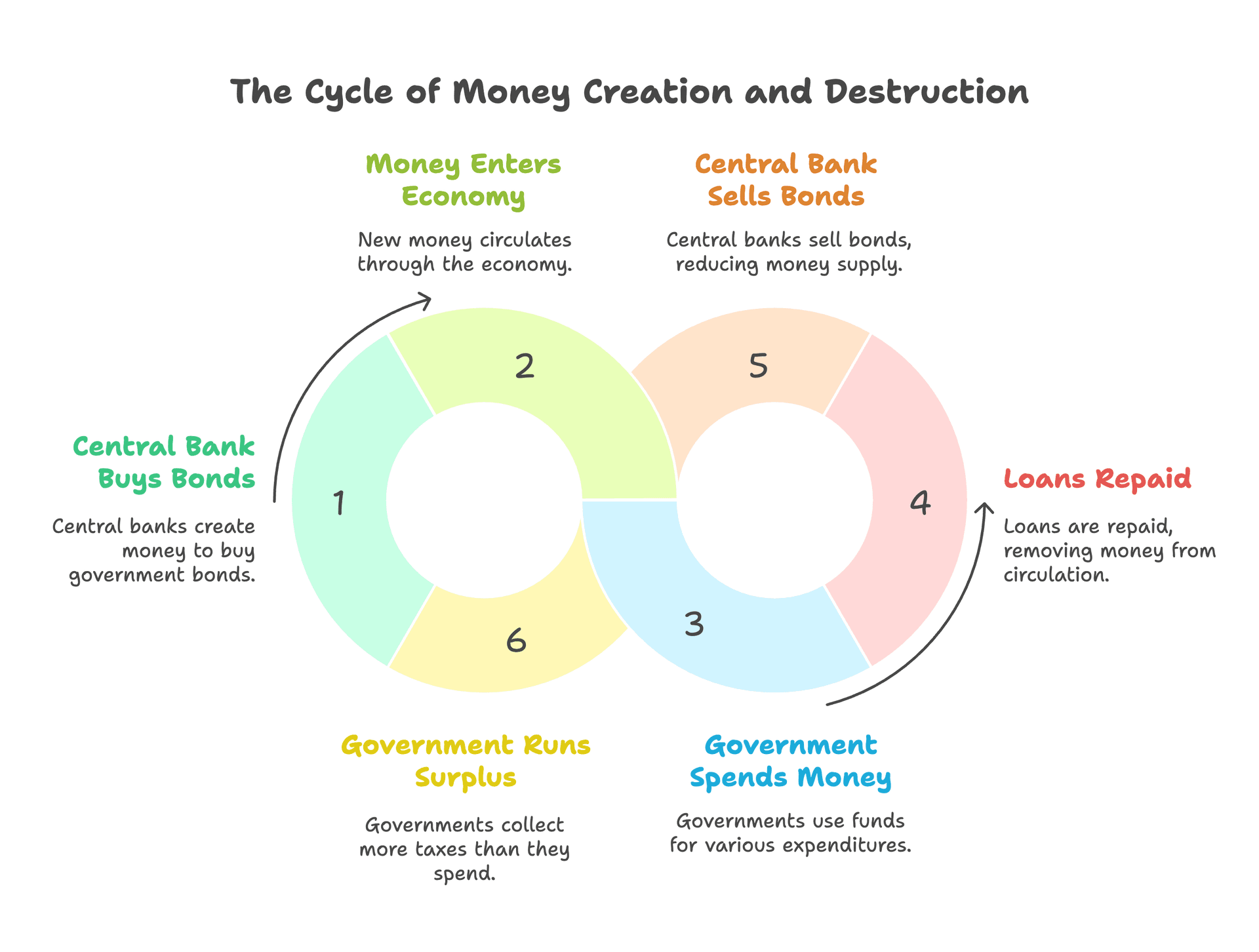
Central Bank Money Creation
Central banks, like the Federal Reserve, create money by:
- Buying bonds: Creating digital money to purchase government debt.
- Lending to banks: Providing new money to banks for lending.
- Quantitative easing (QE): Buying large amounts of government bonds to boost the economy.
Most money creation is digital, not physical cash, and enters the economy through loans or bond purchases.
Government Money Creation
Governments indirectly create money through:
- Deficit spending: Spending more than tax revenue.
- Issuing bonds: Borrowing from investors.
- Central bank coordination: Central banks buying government bonds with new money.
Money Removal
Money removal, or "money destruction" refers to actions that reduce the amount of money circulating in the economy. This impacts spending, borrowing, and investment—helping control inflation, but potentially slowing economic growth if overdone. Here’s how money is removed in practice, with real-world examples:
- Loan Repayments: When you repay a loan to a commercial bank, the principal amount is effectively destroyed—it's no longer circulating in the economy unless the bank re-lends it. During the 2008 financial crisis, deleveraging (repayment and default on debts) led to large-scale money destruction, as banks' balance sheets shrank. For example, if you pay off a $20,000 student loan, that $20,000 disappears from the money supply unless it's lent out again.
- Central Bank Bond Sales: When a central bank sells government bonds, it pulls money out of the banking system. In 2018, the Federal Reserve began quantitative tightening—reducing its bond holdings—which absorbed liquidity from the economy. For instance, if the Fed sells $2 billion in Treasury bonds to a bank or investor, that $2 billion is paid to the Fed and removed from circulation.
- Government Budget Surpluses: When a government collects more in taxes than it spends, it reduces the net financial assets in the private sector. For example, in 2000, the U.S. government under President Clinton ran a budget surplus of about $236 billion. That surplus meant less money was flowing back into the economy, effectively reducing private sector wealth. If the government collects $600 billion in taxes but only spends $550 billion, the $50 billion difference is money no longer available for households and businesses.
These mechanisms help rein in inflation by reducing excess liquidity. However, if applied too aggressively, they can constrain economic activity by limiting the funds available for consumption, lending, and investment.
The Federal Reserve: Global Financial Powerhouse
The Federal Reserve (Fed) is the world’s most influential central bank because the U.S. dollar is the global reserve currency.
The Fed’s Goals
The Fed balances two objectives:
- Price stability: Keeping inflation near 2%.
- Full employment: Reducing unemployment.
These goals can conflict, as boosting jobs may increase inflation, and controlling inflation may slow job growth.
The Fed’s Tools
The Fed uses these tools to manage the economy:
- Federal Funds Rate: The rate banks charge each other for short-term loans, influencing all interest rates. Higher rates slow the economy; lower rates stimulate it.
- Quantitative Easing (QE): Buying bonds to inject money and lower long-term rates.
- Reserve Requirements: Setting how much money banks must hold, affecting lending.
- Forward Guidance: Communicating future plans to shape market expectations.
Fiscal Policy: Spending and Taxes
Governments control fiscal policy through:
- Spending: On infrastructure, education, healthcare, defense, or social programs.
- Taxation: Income, capital gains, corporate, or sales taxes that shape behavior and raise revenue.
- Deficits/Surpluses: Deficits stimulate the economy but increase debt; surpluses reduce debt but slow growth.
Balancing Growth and Inflation
Policies to boost growth (e.g., lower rates, more spending) can raise inflation. Policies to curb inflation (e.g., higher rates, less spending) can slow growth. Finding balance is key.
When Policies Clash
Conflicts between fiscal and monetary policy can create economic instability by pulling the economy in opposing directions. These tensions arise when government spending and taxation goals misalign with central bank efforts to manage money supply and interest rates. Below are key scenarios with relevant 2025 examples:
- Fiscal Dominance: When government borrowing grows excessively, it pressures central banks to maintain low interest rates to ease debt servicing, potentially fueling inflation. For example, in 2025, some advanced economies, like the U.S., face rising deficits due to increased infrastructure spending and tax cuts proposed during the 2024 election cycle. If the Federal Reserve keeps rates low to accommodate this borrowing, it risks higher inflation, as seen in early 2021 when fiscal stimulus contributed to persistent price increases.
- Monetary Dominance: When central banks prioritize controlling inflation over supporting government spending, they may raise interest rates, constraining fiscal policy. In 2025, the European Central Bank (ECB) has tightened monetary policy to address lingering services inflation, with rates held steady despite eurozone governments planning fiscal expansions for green energy transitions. This has forced some governments to scale back spending or raise taxes to manage higher borrowing costs, potentially slowing economic growth.
These conflicts highlight the need for coordination to avoid destabilizing the economy, as misaligned policies can lead to inflation spikes, currency volatility, or reduced growth.
Global Impact
Fiscal and monetary policies shape more than just local economies—they influence exchange rates and global investment flows, affecting currency values, travel costs, and international trade. Here’s how these policies impact the world in 2025, with practical examples and what they mean for you:
Policy Effects on Exchange Rates
Higher interest rates attract foreign investors seeking better returns, increasing demand for a country’s currency and strengthening it. Large deficits or excessive money printing (e.g., quantitative easing) can weaken a currency by raising inflation fears or oversupplying money.
Example: In 2025, the U.S. Federal Reserve keeps interest rates high (around 4-4.5%) to manage inflation, strengthening the U.S. dollar against the euro. Meanwhile, Japan’s near-zero rates to support growth weaken the yen.
Real-Life Impact: A stronger dollar lowers costs for U.S. consumers buying imported goods, like European vacations or Japanese electronics, but makes U.S. exports pricier, potentially hurting manufacturers. A weaker yen boosts Japanese exports like cars but raises import costs, such as oil, for Japanese households.
Investor Behavior and Capital Flows
Investors move money to countries with higher real interest rates (adjusted for inflation) for better returns, but avoid those with risky fiscal policies, like large deficits or political instability.
Example: In 2025, Canada’s stable fiscal policy and moderately high interest rates draw capital from global pension funds, boosting the Canadian dollar. Conversely, some Latin American countries with high deficits face capital flight, weakening their currencies.
Real-Life Impact: Capital inflows stabilize Canada’s economy, funding investments. Capital flight, like Argentina’s 2023 peso devaluation, raises borrowing costs and local prices for goods, impacting everyday affordability.
These dynamics affect your finances. A stronger currency makes international travel and imports cheaper but can harm local exporters. A weaker currency boosts exports but raises costs for foreign goods and travel. Understanding these effects helps you plan investments and global purchases wisely.
Policy Limits
Fiscal and monetary policies are powerful, but they face significant constraints that limit their effectiveness. Understanding these limits helps explain why policymakers can’t always solve economic challenges quickly. Below are the key limitations, with 2025 examples and their real-world implications:
Monetary Policy Constraints
Central banks face boundaries in how far they can push monetary tools like interest rates and quantitative easing (QE).
- Zero Lower Bound: Interest rates can’t drop much below zero, as negative rates discourage saving and disrupt banking systems.
- Diminishing QE Returns: QE, where central banks buy bonds to inject money, becomes less effective over time as markets adjust.
Example: In 2025, the European Central Bank (ECB) struggles to stimulate growth in the eurozone because interest rates are already near zero. Further QE, as seen in Japan’s prolonged bond-buying program, yields limited results, with investors less responsive after years of low rates.
Real-Life Impact: When rates are stuck near zero, savers earn minimal returns on bank deposits, pushing them toward riskier investments like stocks. Limited QE effectiveness means central banks may struggle to boost economies during downturns, affecting job creation and wage growth.
Fiscal Policy Constraints
Government spending and taxation decisions are limited by economic, political, and practical factors.
- Debt Sustainability: Deficits can’t grow faster than the economy indefinitely, or debt becomes unmanageable.
- Political and Timing Issues: Political gridlock and delays in passing budgets or reforms slow down fiscal responses.
Example: In 2025, the U.S. government faces pressure to curb deficits as the national debt exceeds 120% of GDP, raising concerns about long-term sustainability. Political debates over tax hikes, as seen in stalled U.S. budget negotiations, delay critical infrastructure spending, limiting economic stimulus.
Real-Life Impact: Unsustainable debt can lead to higher taxes or reduced public services in the future, affecting your disposable income. Delays in fiscal policy mean slower responses to economic crises, potentially prolonging recessions or unemployment.
These constraints mean policymakers must balance short-term needs with long-term stability, impacting your financial planning, from savings to investment strategies.
How This Affects You
These policies impact your finances:
- Interest Rates: Low rates help borrowers; high rates benefit savers.
- Inflation: High inflation hurts cash savings; moderate inflation boosts assets.
- Currency: Policy shifts affect exchange rates, impacting international investments.
Key Takeaways
- Governments manage spending and taxes; central banks control money and rates.
- Money is created through bonds and loans, removed when repaid or absorbed.
- Interest rates drive economic cycles, balancing growth and inflation.
- Policy conflicts can cause economic instability.
- Understanding policies helps you plan your finances.
With a clearer view of the economic system, you’re ready to focus on personal finance: earning, spending, saving, and investing wisely.