When most people think about the "cost" of something, they think about the price tag. But the real cost of anything isn't just the money you spend—it's what you give up to get it. This concept, called opportunity cost, is one of the most important ideas in personal finance.
Beyond the Price Tag
Every financial decision you make is really a choice between different possible futures. When you spend $5 on coffee, you're not just spending $5—you're choosing coffee over everything else you could have done with that money. You're choosing immediate gratification over future investment returns. You're choosing convenience over cooking at home.
This is opportunity cost: the value of the best alternative you give up when making a choice. It's not just about money—it's about time, energy, and all the other paths you could have taken.
The Time Value of Money
Here's a fundamental truth: a dollar today is worth more than a dollar tomorrow. This isn't just about inflation (though that's part of it). It's about the potential that money has to grow over time through investment.
Let's say you have $1,000 today. You could spend it on a vacation, or you could invest it in the stock market at an average annual return of 7%. Here's what that choice looks like over time:
- Today: $1,000 vacation vs. $1,000 investment
- 10 years: Memories vs. $1,967
- 20 years: Memories vs. $3,870
- 30 years: Memories vs. $7,612
This doesn't mean you should never take vacations—experiences have value too. But it does mean you should understand the true cost of your choices.
The Power of Compound Interest
Albert Einstein allegedly called compound interest "the eighth wonder of the world." Whether he actually said it or not, the sentiment is true. When you invest money, you earn returns not just on your original investment, but on all the returns you've earned in previous years.
This is why starting early is so powerful. Someone who invests $200 per month starting at age 25 will have more money at retirement than someone who invests $400 per month starting at age 35, assuming the same rate of return. Time is the most powerful factor in building wealth.
Opportunity Cost in Everyday Life
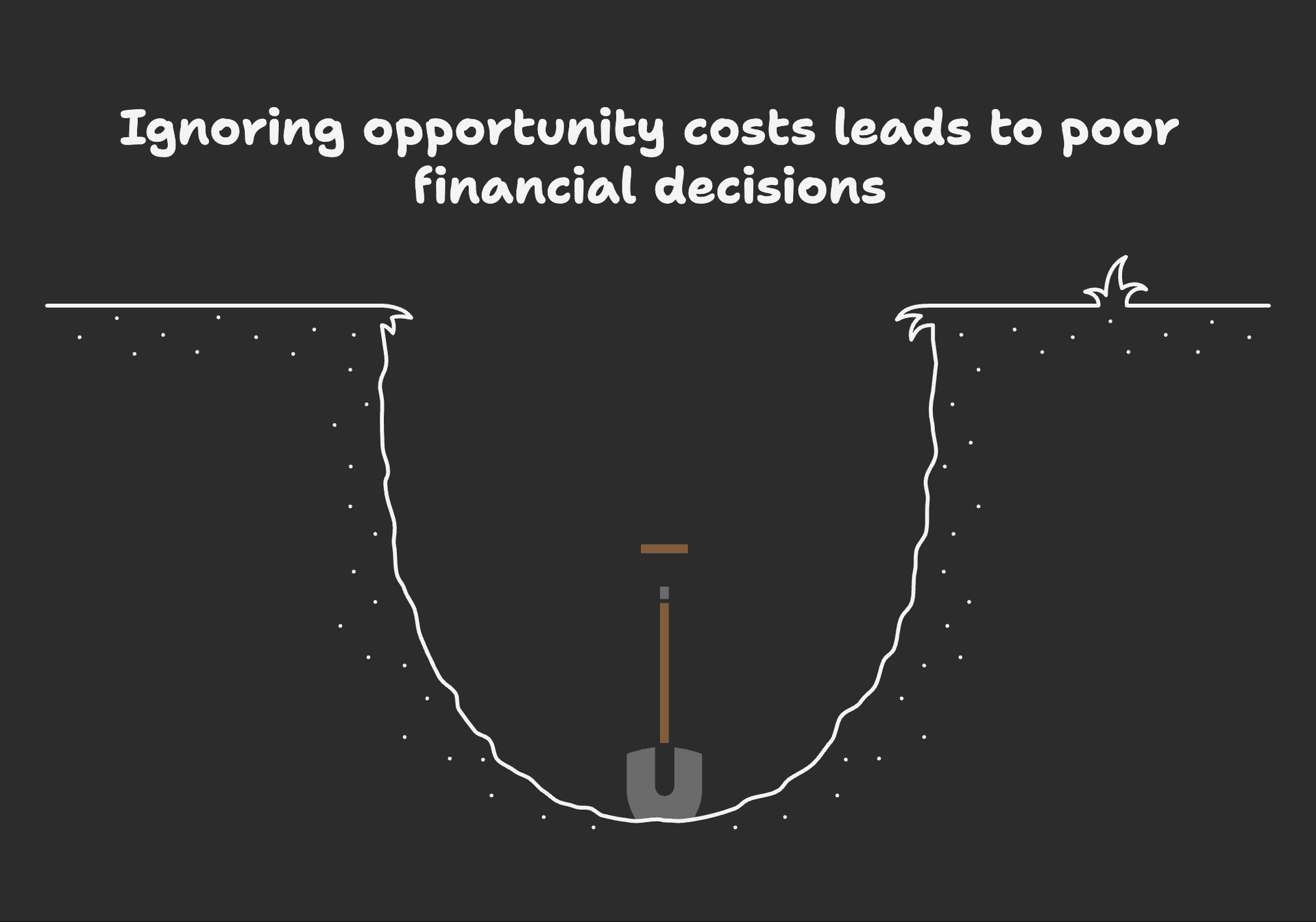
Let's look at some common examples of opportunity cost that might surprise you:
The Daily Coffee
That $5 daily coffee habit costs $1,825 per year. If you invested that money instead at 7% annual returns, you'd have about $138,000 after 30 years. This doesn't mean you should never buy coffee, but you should understand what you're giving up.
The Car Payment
The difference between a $50,000 luxury car and a $25,000 reliable car is $25,000. Invested over 30 years at 7% returns, that difference becomes about $190,000. The luxury car needs to provide $190,000 worth of additional value to justify the cost.
The Career Choice
Opportunity cost isn't always about money. If you choose a lower-paying job you love over a higher-paying job you hate, the opportunity cost includes the salary difference, but the benefit includes your happiness, work-life balance, and personal fulfillment. Sometimes the non-financial benefits outweigh the financial costs.
A Mental Model: Voting on Your Future Self
Here's a powerful way to think about every dollar you spend:
Every dollar you spend today is a vote on what kind of future you want.
- Spending on experiences: You're voting for memories and personal growth
- Spending on assets: You're voting for future financial freedom
- Spending on consumption: You're voting for immediate gratification
- Spending on education: You're voting for increased earning potential
- Spending on health: You're voting for longevity and quality of life
None of these choices are inherently right or wrong. The key is to make them consciously, understanding what you're voting for with each decision.
Time as Your Most Valuable Asset
Money is renewable—you can always earn more. Time is not. This makes time your most valuable asset, and it changes how you should think about financial decisions.
The Hourly Wage Perspective
One useful exercise is to calculate your true hourly wage. If you make $60,000 per year working 50 hours per week for 50 weeks, your hourly wage is $24. That $120 dinner represents 5 hours of your life. Is it worth it? Sometimes yes, sometimes no—but you should make that choice consciously.
Buying Back Your Time
As your income grows, you can start "buying back" your time by paying others to do things you don't enjoy or aren't good at. Hiring a house cleaner, using grocery delivery, or paying for lawn care can free up time for more valuable activities—like spending time with family or working on side projects that could increase your income.
Practical Applications
Before making any significant financial decision, ask yourself these questions:
- What am I giving up? What else could I do with this money?
- What's the time cost? How many hours did I work to earn this money?
- What future am I voting for? Does this align with my long-term goals?
- Is this the best use? Could this money create more value elsewhere?
The 24-Hour Rule
For purchases over a certain threshold (maybe $100 or $500, depending on your income), implement a 24-hour waiting period. This gives you time to consider the opportunity cost and make sure you're making a conscious choice rather than an impulsive one.
Automate Your Future Self
One of the best ways to ensure you're voting for your future self is to automate your savings and investments. Set up automatic transfers to your investment accounts so the money is invested before you have a chance to spend it. Pay your future self first.
When Opportunity Cost Analysis Goes Wrong
While opportunity cost is a powerful concept, it's possible to take it too far. Some people become so focused on the theoretical returns they could earn that they never spend money on anything enjoyable. This is a mistake.
Money is a tool, not a goal. The purpose of understanding opportunity cost isn't to never spend money—it's to spend money consciously on things that truly add value to your life.
The Paradox of Choice
Understanding opportunity cost can sometimes make decisions harder, not easier. When you realize that every choice has a cost, it can lead to analysis paralysis. The key is to use opportunity cost as a framework for thinking, not as a reason to avoid making decisions.
Remember: not making a decision is itself a decision. If you spend months researching the perfect investment while your money sits in a checking account earning 0.01%, the opportunity cost of your indecision may be higher than the cost of making a slightly suboptimal choice.
Key Takeaways
- The real cost of anything includes money, time, and opportunity cost
- A dollar today is worth more than a dollar tomorrow due to investment potential
- Every spending decision is a vote on your future self
- Time is your most valuable asset because it's non-renewable
- Use opportunity cost as a framework for conscious decision-making, not paralysis
In our next chapter, we'll explore how inflation affects your money over time and why understanding the difference between nominal and real returns is crucial for long-term financial planning.